
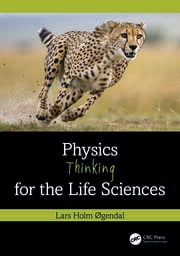
E-Book
Physics Thinking for the Life Sciences
ISBN : 9781003435921
Author : Lars Holm Øgendal
Publisher : CRC Press
Year : 2026
Language : English
Type : E-book
Cuncurrent Users : Unlimited
Description : ABSTRACT This textbook provides an introduction to the physics of life science, focusing on applying physics thinking to understanding biological systems such as whole organisms, organs, single cells, biomolecules, or materials of biological origin (e.g. foodstuffs). It is divided into three parts, the first explores macroscopic physics. Chapters discuss motion, force, and energy and apply these concepts to solid and liquid materials as well as organs and whole organisms. The second part of the book considers microscopic physics, which deals with molecular behaviour, e.g. protein folding/ unfolding, diffusion, and self-organization. The final part focuses on mesoscopic physics, applying the concepts from the preceding chapters to the description and understanding of aspects of living cells. Readers are expected to be familiar with ordinary algebra and elementary functions (including exponential, logarithms and trigonometric functions) but not more advanced mathematics, like calculus or vectors. Calculus and vectors are used sparingly, mainly for illustration, but are not required for solving the problems included with each chapter. These problems are directly relevant to life science and aim to teach readers how to use physics in their fields. This book will be a valuable textbook for first-year students in life science fields like biology, biochemistry, biophysics, biotechnology, food science, medicine, veterinary science, and pharmaceutical science. Key features: Algebra‑based and beginner‑friendly. Includes examples and problem sets with answers in every chapter. Accompanied by a solutions manual for instructors.
RECOMMENDED BOOKS
Digital Humanism
Hannes Werthner

Immoral Traffic
Vibhuti Ramachandran

Reading behind the lines
Natasha Alden
Digital Heritage and Cultural Tourism
Marinos Ioannides
Advanced Topics in Inverse Data Envelopment Analysis: Approaches for Handling Ratio Data
Mehdi Soltanifar

Air Pollution, Air Quality, and Climate Change
Angelo Basile
Inside Organizational Culture: Theory and Practice
Alan S. Gutterman

Embedded Linux essentials handbook: build embedded Linux systems and real-world apps with Yocto, Buildroot, and RPi
Mohammed Billoo