
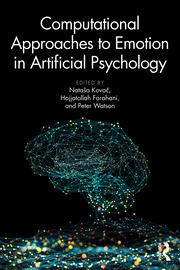
Book
Computational approaches to emotion in artificial psychology
ISBN : 9781032795867
Author : Nataša Kovač
Publisher : Routledge
Year : 2027
Language : English
Type : Book
Description : Computational Approaches to Emotion in Artificial Psychology provides readers with a comprehensive introduction to how emotions can be processed by AI systems. It offers theoretical and practical guidance on data preprocessing and emotion analysis techniques, explores diverse real-world applications, and bridges the gap between AI and psychology. Beginning with an introduction to the emerging field of artificial psychology, it explores the study, understanding, and recognition of emotions in various bodily signals, including facial expressions, voice, heart rate, and neural mechanisms. The book delves into data preprocessing for embodied emotion analysis, encompassing multiple data modalities like text, audio, visual, and gaze data, with a focus on Python basics for emotional AI. Additionally, it discusses EEG-based emotion decoding, emotional insights from medical imaging, affective image analysis, text-based emotion recognition, multimodal data integration, unsupervised learning for embodied emotion discovery, reinforcement learning, emotion elicitation, and predicting personality and emotional abilities using machine learning. The book concludes by examining the close relationship between cognition and emotion from the perspective of the universal structure of language and describing the use of deep fuzzy cognitive maps in diagnosing coronary artery disease. By promoting research and innovation through case studies and experiments, the book addresses the current lack of comprehensive resources in this interdisciplinary field, making it an essential reference for researchers, practitioners, students, and professionals seeking to navigate the intersection of AI and emotions.
RECOMMENDED BOOKS
Society, Politics, and Education in Uncertain Times
Harry Dyer

Mathematical structures
Joachim Hilgert

Anthony's textbook of anatomy & physiology
Kevin T. Patton
Artificial Intelligence in Public Health
Min Wu
Artificial intelligence and machine learning algorithms for engineering applications
Krishan Arora
Aquaculture with Artificial Intelligence
Baskaralingam Vaseeharan

Higher Vocational Education and Skill Formation in China
Jie Xiong
Revolutionary impact of 5G on advancement of technology in healthcare
Mritunjay Rai