
Book
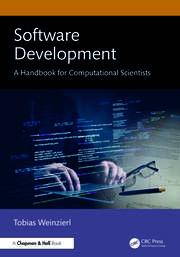
Software Development
ISBN : 9781041274889
Author : Tobias Weinzierl
Publisher : CRC Press
Year : 2026
Language : English
Type : Book
Description : Preface Disclaimer Author I The ecosystem 1 Context and environment 1.1 Computational research and its software 1.2 Research software as research group product 1.3 Code use and code reuse 1.4 Requirements of computational software 1.5 Success metrics 1.6 Sequences of grants as defining framework behind the development process 1.7 Developers vs. users 1.8 Development teams and roles 1.9 Working arrangements 1.10 The Tower of Babel: A common project language 1.11 Accountability, socialisation and job profile 1.12 Wrap-up II Principles and doctrines 2 Artefact organisation 2.1 Let there be version control 2.2 Repository structure and organisation 2.3 The truth is (not) in the code 2.4 less, tail and vi are all you need 2.5 Style conventions 2.6 Certain files, outputs and links are mandatory 3 Artefact quality 3.1 Architecture matters 3.2 Different natures and flavours of documentation 3.3 Functional decomposition and the myth of common language 3.4 Systematic testing 3.5 Validation and correctness 3.6 Non-functional requirements 3.7 Branches have to be stable 4 Behaviour 4.1 Never hide work in progress 4.2 Code ownership: Accept responsibility, respect others’ code 4.3 Add (scientific) value 4.4 Automate everything 4.5 Document rationale 4.6 Read and write 4.7 Conventions follow function III Techniques 5 Collaborate and communicate 5.1 Pair programming is difficult 5.2 Pair debugging helps 5.3 Generative AI: Speak to the computer 5.4 Don’t answer questions 5.5 Don’t use private, direct communication 5.6 Communicate in present tense 6 Branching and merging 6.1 One feature, one task, one branch 6.2 Favour trees 6.3 Top-down merges: Frequent and automatic 6.4 Branch lifetime and merge frequency 6.5 Monitor the quality of branches 6.6 Merges are allowed to break the code 6.7 Extract and split merge requests 7 Code review 7.1 Never alter an existing merge/pull request 7.2 Reviewers should fix minor issues 7.3 Do not discuss 7.4 Pick reviewers carefully 7.5 Team morale and the categorical imperative 8 Debugging 8.1 Distinguish debugging from coding 8.2 Explain and document 8.3 Don’t fix bugs: Write tests 8.4 Prioritise and classify bugs 8.5 Debug eventually 8.6 Keep debugging code output 8.7 Don’t write reproducers or mini-apps 8.8 Avoid debugging 9 Tests 9.1 Unit tests 9.2 System and integration tests as community benchmarks 9.3 Cover performance by tests 9.4 Microbenchmarks 10 Defensive programming 10.1 Assertions 10.2 Exceptions and error codes 10.3 Add timeouts to all communication and synchronisation routines 10.4 State transitions 10.5 Maintain different build variants 11 Ingredients of good documentation and architecture descriptions 11.1 Documentation format 11.2 Location of documentation 11.3 In-line documentation 11.4 Create cartoons 11.5 Formal techniques: Preconditions, invariants and assertions 11.6 Add TEX formulae 11.7 Hyperlinks and literature 11.8 Challenge documentation guidelines 12 How to write documentation and architecture documents 12.1 Quality guidelines 12.2 Documentation first 12.3 Generate documentation automatically 12.4 Never throw documentation away: Make it a history lessons 12.5 Embrace multilinguality 12.6 Active code reading 12.7 Tutorials and how-tos: Document by example 12.8 Unit tests 12.9 Papers IV Structure and organisation 13 Workflows 13.1 Continuous integration 13.2 Run checks prior to a merge request 13.3 Throw ballast over board 13.4 Careful refactoring 13.5 Performance engineering vs. refactoring 13.6 Development environments and toolchains 13.7 Challenge nature and timing of experiments 14 Organise your day-to-day work 14.1 Task granularity 14.2 Goal- vs. activity-oriented tasks 14.3 Have a plan B 14.4 No 9-to-5: Prepare for interruption 14.5 Speak about your plans in public 14.6 Prioritise reviews 14.7 Own your time: Prioritise tasks 14.8 Important meetings 15 Interacting with stakeholders 15.1 Tailored mission statements and tasks 15.2 Goal-oriented meetings 15.3 The how vs. what paradox 15.4 Tests as specification 15.5 User stories, storyboard and papers 15.6 External code users 16 Closing remarks Bibliography V Appendix A Correlation of context, principles and techniques A.1 List of principles and doctrines A.2 Mapping of context to principles A.3 Mapping of techniques to doctrines B Discussion of sources B.1 Research environment B.2 Job roles and role models B.3 Development workflows B.4 Requirement engineering B.5 Team constellation and characteristics B.6 Classification of best practices B.7 Version control B.8 Software architecture B.9 Documentation B.10 Code quality B.11 Collaboration B.12 Performance B.13 Code ownership, external contributions and refactoring B.14 Managing complexity and self-organisation C Further resources C.1 Resource collections on the web C.2 Software D Chapter summaries Index
RECOMMENDED BOOKS
Smart Technologies for Sustainable Agriculture
Wasswa Shafik
Sustainable Technologies for Value Addition and Management of Plastic Waste
Abha Kumari
The podiatry institute
Chandler Ligas
Blue Biotechnology
Marco F.L. Lemos
Advanced Pediatric Surgery: Passing the specialist surgical exams
Shailinder Jit Singh
Vitamins and Neurodegeneration Mechanisms and Therapeutic Insights
Sachchida Nand Rai

Antiracism Nursing and Midwifery
Musharrat Ahmed-Landeryou
Big Data Analytics for Strategic Business Decisions
Neha Gupta