
Book
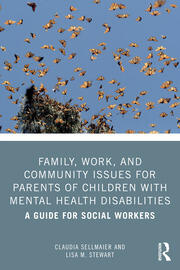
Family, Work, and Community Issues for Parents of Children with Mental Health Disabilities
ISBN : 9781032847375
Author : Claudia Sellmaier
Publisher : Routledge
Year : 2027
Language : English
Type : Book
Description : 1. Understanding Mental Health Disabilities in Children Part 1: The Challenges in Defining Mental Health Disabilities in Children Part 2: Prevalence Data (Global and U.S.) Part 3: The Short- and Long-term Impacts of Parenting a Child with a Disability Part 4: Causes and Risk Factors Associated with Mental Health Disabilities in Children Part 5: Early Intervention as a Site of Uncertainty and Uneven Access Part 6: Summary and Key Points Part 7: Application for Social Work Education 2. Exceptional Care as a Social Justice Issue Part 1: Disability Theories Part 2: Disability: Rights and Justice Part 3: Exceptional Care in the Context of Disability Theories Part 4: Social Work Ethics and the Grand Challenges Part 5: Summary: Exceptional Care as a Social Justice Issue Part 6: Implications for Social Work Practice Part 7: Application for Social Work Education 3. The Community, Work, and Family Interface: Theoretical Analysis Part 1: Situating Exceptional Care in Relation to Other Life Roles Part 2: Life Course, Boundaries, and Ecological Contexts in Parenting a Child with a Mental Health Disability Part 3: Disability, Stigma, and Family Adaptation in Parenting a Child with a Mental Health Disability Part 4: The Continuum of Dependent Care and the Dynamics of Work-Family Fit Part 5: Twenty Years of Research on Parenting, Work, and Community – Clarifying Key Drivers of Fit and Misfit Part 6: Summary and Key Points Part 7: Application for Social Work Education 4. The Family System Part 1: Effects of Exceptional Care on Parents Individually and on their Relationship Part 2: Effects on Immediate and Extended Family Members Part 3: Effects on Sibling Relationships Part 4: Family Resilience Part 5: Summary and Key Points Part 6: Recommendations for Social Work Practice Part 7: Application for Social Work Education 5. The Work-Family Dilemma Part 1: Understanding Work-Family Integration Part 2: The Time Bind and the Crisis-Oriented Nature of Care Part 3: The Workplace Flexibility Dilemma and Employment Precarity Part 4: Disclosure Under Courtesy Stigma and Flexible Precarity Part 5: The Financial Strain Associated with Caring for a Child with a Mental Health Disability Part 6: The Conditional and Protective Role of Work Part 7: Implications for Social Work Practice Part 8: Summary and Key Points Part 9: Application for Social Work Education 6. Social Support and Community Resources Part 1: Research about Child Care and Schools Part 2: Research about Medical and Therapeutic Services Part 3: Peer Support Part 4: Respite Care Part 5: Summary and Key Points Part 6: Recommendations for Social Work Practice Part 7: Application for Social Work Education 7. The Effects of the Covid-19 Pandemic Part 1: Changes in Work and Community Systems, and Policy Part 2: How these Changes Affected Families Part 3: Trends Now and Long-term Effects Part 4: Summary and Key Points Part 5: Implications for Social Work Practice Part 6: Application for Social Work Education 8. Comparative Analysis of Developed Countries’ Policies Part 1: Comparative Policy Framework Part 2: Health Care Coverage and Mental Health Policy Responses Part 3: Education Systems and Early Childhood Policies Part 4: Financial Supports, Leave Policies, and Income Security Part 5: Anti-Discrimination Policies Part 6: Cross-Domain Synthesis and Policy Implications: A Disability Rights Perspective Part 7: Implications for Social Work and Social Welfare Policy Part 8: Summary and Key Points Part 9: Application for Social Work Education 9. Emerging Trends and Innovations Part 1: Workplace Interventions Part 2: Family Interventions Part 3: Social and Workplace Policies Part 4: Summary and Key Points Part 5: Implications for Social Work Practice Part 6: Application for Social Work Education 10. Summary and Future Directions Part 1: Uncertainty as a Throughline for Exceptional Caregiving Part 2: Cross Domain Patterns in Parent Experiences Part 3: Rethinking Support under Conditions of Uncertainty Part 4: Research Direction and Emerging Tools Part 5: Conclusion
RECOMMENDED BOOKS

Detection and Quantification of Bacteria, Yeast, Viruses, and Protozoan in Foods and Freshwater
Marciane Magnani
Ageing, Learning and Development
Tania Zittoun

Experimental research
J. Carlos Santamarina

Biotoxins in food
Sesan Abiodun Aransiola

Smart Wearables, Nanofibers, and Textiles
Majid Montazer

AI Agent Evaluation
Abdullah Mansoor

Essentials of global health
Babulal Sethia
Health Policy for Advanced Practice Nursing
Kathy J. Wheeler