
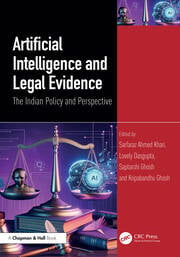
E-Book
Artificial Intelligence and Legal Evidence
ISBN : 9781003629146
Author : Sarfaraz Ahmed Khan
Publisher : Chapman and Hall/CRC
Year : 2026
Language : English
Type : E-book
Cuncurrent Users : Unlimited
Description : ABSTRACT This book explores AI’s impact on legal evidence, with a particular focus on its use within Indian law, by identifying the key feature of an Artificial intelligence-driven Justice Delivery System. It seeks to bridge the gap in the literature on the intersection of AI and law, specifically the evaluation of evidence. The book focuses on AI’s potential to enhance the evaluation of evidence in various legal contexts. It considers the reliability, admissibility, and standardisation of AI-generated evidence in legal proceedings. The key features of the book are: • Presents case studies and examples from multiple branches of law, exploring AI’s use in evidence collection, analysis, and evaluation across diverse legal domains. • Offering a unique perspective on AI and legal evidence within India, the book provides a critical look at how AI can be integrated into India’s legal framework and the implications for the country’s judicial system. • Addresses the policy gaps and regulatory frameworks needed to govern AI in the legal sphere, with a focus on India's evolving stance on AI. • Emphasizes the need for ethical standards and privacy protection while using AI to evaluate legal evidence, examines the challenges in ensuring the validity and fairness of AI-generated evidence. • Highlights the future potential of AI in transforming the legal industry, particularly in terms of improving efficiency, reducing bias, and enabling more effective evidence evaluation. The book will be useful for academicians and scholars interested in Artificial Intelligence’s impact and use in the legal system.
RECOMMENDED BOOKS

Exploring Asian-Pacific Co-operatives in Theory and Practice: Resilience and Thriving between the State and the Market
Morris Altman

The Silent Rebellion
Chris Lewis
Translanguaging in Classroom Discourse
Kevin W. H. Tai

Carbon-Negative Farming
Farooq Ahmad Khan
The Hidden Project Drivers: Building Behavior that Drives Success
Kursten Faller

Hyper-Digital Marketing
Vanitha Swaminathan
Human-Centered Automation
Carlos Toxli-Hernandez
Corruption and the Voter's Decision
Miguel F. P. de Figueiredo