
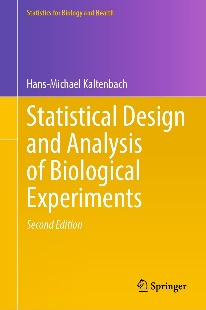
Book
Statistical Design and Analysis of Biological Experiments
ISBN : 9783032150646
Author : Hans-Michael Kaltenbach
Publisher : Springer
Year : 2026
Language : English
Type : Book
Description : This richly illustrated book provides an overview of the design and analysis of experiments with a focus on non-clinical experiments in the life sciences, including animal research. It covers the most common aspects of experimental design such as handling multiple treatment factors and improving precision. In addition, it addresses experiments with large numbers of treatment factors and response surface methods for optimizing experimental conditions or biotechnological yields. The book emphasizes the estimation of effect sizes and the principled use of statistical arguments in the broader scientific context. It gradually transitions from classical analysis of variance to modern linear mixed models and provides detailed information on power analysis and sample size determination, including ‘portable power’ formulas for making quick approximate calculations. In turn, detailed discussions of several real-life examples illustrate the complexities and aberrations that can arise in practice. Chiefly intended for students, teachers and researchers in the fields of experimental biology and biomedicine, the book is largely self-contained and starts with the necessary background on basic statistical concepts. The underlying ideas and necessary mathematics are gradually introduced in increasingly complex variants of a single example. Hasse diagrams serve as a powerful method for visualizing and comparing experimental designs and deriving appropriate models for their analysis. Manual calculations are provided for early examples, allowing the reader to follow the analyses in detail. More complex calculations rely on the statistical software R, but are easily transferable to other software. This second edition includes a separate chapter on the interplay between design and analysis, which discusses the construction and interpretation of Hasse diagrams, the definition of linear models that match a design, and the specification of these models in statistical software. In addition, a new chapter covers the use of additional (concomitant) measurements to improve precision, as well as baseline measurements, which are frequently encountered in biological experiments.
RECOMMENDED BOOKS

Handbook of Nitrous Oxide and Oxygen Sedation
Ann L. Brunick

Criminal Law and Criminal Justice
Amy Elkington

Fundamental structures of the chinese language
Taciana Fisac

Introduction to Medical Virology: Theory and Practice in Tropical Countries
Oluwatayo Israel

Ozone Applications in the Food Industry
Ravi Pandiselvam
Practical neural networks in python and matlab
Chunwei Zhang

Trauma informed care
Sophie Isobel

Williams' Basic Nutrition & Diet Therapy
Staci Nix