Book
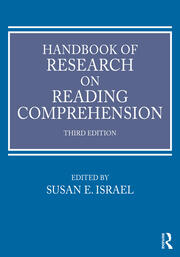
Handbook of Research on Reading Comprehension
ISBN : 9781041033875
Author : Susan E. Israel
Publisher : Routledge
Year : 2026
Language : English
Type : Book
Description : Contents Forewords Preface Acknowledgements About the Editor Contributors & Affiliations Part I: FOUNDATIONS: Ways of Knowing and Doing 1. Introduction: Examining Comprehension Through New Lenses Susan E. Israel 2. The Roots of Reading Comprehension Instruction P. David Pearson and Gina N. Cervetti 3. Professional Development in an Era of Literacy Mandates: Teaching Comprehension in the United States and in the World Barbara Laster and Carla Finkelstein Part II: Theoretical Perspectives 4. Advancing an Equity-Oriented, Sociocultural Account of Reading Comprehension Gina N. Cervetti, Cynthia Greenleaf, Kathleen A. Hinchman, and P. David Pearson 5. Understanding the Nature of Reading Comprehension: Viewing Comprehension as a Multifaceted Phenomenon Chaeyun Lee 6. Reading Comprehension as Social Practice(s) in Social Events David Bloome, Ayanna F. Brown, and Maria Beatriz Pinto 7. Theoretical Transformations in Comprehension: Reflections on the Past and Visions for the Future Thilina I. Wickramaarachchi, Rick Fisher, Laurie “Darian” Thrailkill, Adeline M. Borti, and Cynthia H. Brock Part III: DEVELOPMENTAL IMPACT 8. The Roles of Oral Language and Knowledge Development In Supporting Text Comprehension for Young Children Tanya S. Wright, Sonia Q. Cabell, and HyeJin Hwang 9. Using Assessments to Map and Evaluate the Comprehension Development of Young Children Katherine A Dougherty Stahl and Georgia Earnest Garcia 10. Choosing Texts for Comprehension Sarah M. Lupo and Elfrieda H. Hiebert 11. Reading Fluency and Comprehension Development Melanie R. Kuhn and Megan M. Gregory 12. Vocabulary and Reading Comprehension: More Than a Simple Equation Gwynne Ellen Ash, Jodi P. Holschuh, and James F. Baumann Part IV: TEXT PROCESSING AND KNOWLEDGE ACQUISITION 13. The Connection Between Reading Comprehension and Written Composition: Theory and Evidence Young-Suk Grace Kim 14. The Knowledge-Comprehension Connection: Activating, Building, And Revising Knowledge During Reading Courtney Hattan, Jackie E. Relyea, and Yuzi Gao 15. More than Words: Examining Reading Comprehension as an Act of Communication Jennifer Frean 16. Self-Regulation with Agency: A Path Less Traveled Dixie D. Massey and Samuel D. Miller Part V: DIGITAL TEXT COMPREHENSION AND STRATEGIES 17. Background Research on Historical, Social, and Cultural Factors Shaping Students: Reading Comprehension of Digital, Multimodal Texts Richard Beach, Robert J. Tierney, and Blaine E. Smith 18. Constructing Meaning through Discussion Janice F. Almasi, Keli Garas-York, Temidayo Jaiyesimi, Caitlin McClure and Zachary Milford 19. Research on Informational and Digital Text Comprehension John Z. Strong, Laura S. Tortorelli, and Sharon Walpole Part VI: CULTURE, EQUITY, AND ENGAGEMENT 20. Reading Comprehension Research from an Intersectional Lens: Examining the Knowledge Base in the Context of Race, Language and Disability Endia J. Lindo and Amy M. Elleman 21. Family Literacy and Reading Comprehension: Evolving Understandings and Emerging Directions Marliese R. Peltier, Patricia A. Edwards, and Jacquelyn Sweeney 22. Perspectives on Reading Comprehension for Multilingual Learners Anne C. Ittner, Jackie Caires-Hurley, and Annie Delbridge 23. Racial Literacies and Comprehension: Readers, Histories, Contexts, Texts, Practices, Assessments, and Intersubjective Meanings before/since/beyond 21st Century Race Customs of the U.S. Marcus Croom Part VII: FUTURE DIRECTIONS 24. Public Policy in the Era of Pandemic Response and Recovery, The Science of Reading, and New Literacies Cory Stai 25. Where to From Here? Susan E. Israel, Lor Czop Assaf, and Parastoo Abedini Afterword: The Future of Reading Comprehension Analyses: Addressing Methodological Concerns in Order to Advance Conceptual Understanding Susan E. Israel Final Thoughts: How Classroom Teachers Can Benefit from Reading the Handbook of Research on Reading Comprehension, 3rd Edition Index
RECOMMENDED BOOKS
An introduction to cost accounting
Sandeep Goel
Metal-Organic Frameworks for Anticorrosive Coatings
Ashish Kumar
Artificial Intelligence in Medicine and Dentistry
Lobat Tayebi
Becoming a Reflective Practitioner
Christopher Johns
Nutraceuticals in Respiratory and Pulmonary Diseases
Deepika Saini
Creative entrepreneurship
Jennifer A. Reis

The Evolution of Data Protection Laws in China, Japan, and Korea
Hiroshi Miyashita
Clinical Skills and the Skin
Ian Peate