Book
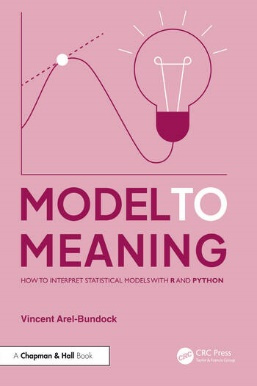
Model to Meaning : How to Interpret Statistical Models with R and Python
ISBN : 9781032908724
Author : Vincent Arel-Bundock
Publisher : CRC Press
Year : 2026
Language : English
Type : Book
Description : Our world is complex. To make sense of it, data analysts routinely fit sophisticated statistical or machine learning models. Interpreting the results produced by such models can be challenging, and researchers often struggle to communicate their findings to colleagues and stakeholders. Model to Meaning is a book designed to bridge that gap. It is a practical guide for anyone who needs to translate model outputs into accurate insights that are accessible to a wide audience. Features: Presents a simple and powerful conceptual framework to interpret the results from a wide variety of statistical or machine learning models. Features in-depth case studies covering topics such as causal inference, experiments, interactions, categorical variables, multilevel regression, weighting, and machine learning. Includes extensive practical examples in both R and Python using the marginal effects software. Accompanied by comprehensive online documentation, tutorials, and bonus case studies. Model to Meaning introduces a simple and powerful conceptual framework to help analysts describe the statistical quantities that can shed light on their research questions, estimate those quantities, and communicate the results clearly and rigorously. Based on this framework, the book proposes a consistent workflow that can be applied to (almost) any statistical or machine learning model. Readers will learn how to transform complex parameter estimates into quantities that are readily interpretable, intuitive, and understandable. Written for data scientists, researchers, and students, the book speaks to newcomers seeking practical skills, and to experienced analysts who are ready to adopt new tools and rethink entrenched habits. It offers useful ideas, concrete workflows, powerful software, and detailed case studies, presented using real-world data and code examples.
RECOMMENDED BOOKS

Aesthetic Ethics
M. Mookie C
Exploring Ancient Chinese Cultural System
Xu Zhongshu
Essential statistics, regression, and econometrics
Gary Smith

Selling Online For Dummies
Paul Waddy
The Anatomy and Physiology Textbook for Midwives
Jane Carpenter

Enzymes: The Worker Bees of the Cell
Thomas W. Traut

Diagnostic Pathology: Nonneoplastic Dermatopathology
Brian J. Hall
Language curriculum design
John Macalister