
Book
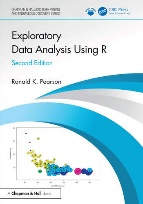
Exploratory data analysis using r
ISBN : 9781032814803
Author : Ronald K. Pearson
Publisher : CRC Press
Year : 2026
Language : English
Type : Book
Description : Exploratory Data Analysis Using R provides a classroom-tested introduction to exploratory data analysis (EDA), and this revised edition is accompanied by the R package ExploreTheData that implements many of the approaches described. As before, the primary focus of the book is on identifying "interesting" features - good, bad, and ugly - in a dataset, why it is important to find them, how to treat them, and more generally, the use of R to explore and explain datasets and the analysis results derived from them. The book begins with a brief overview of exploratory data analysis using R, followed by a detailed discussion of creating various graphical data summaries in R. Then comes a thorough introduction to exploratory data analysis, and a detailed treatment of 13 data anomalies, why they are important, how to find them, and some options for addressing them. Subsequent chapters introduce the mechanics of working with external data, structured query language (SQL) for interacting with relational databases, linear regression analysis (the simplest and historically most important class of predictive models), and crafting data stories to explain our results to others. These chapters use R as an interactive data analysis platform, while Chapter 9 turns to writing programs in R, focusing on creating custom functions that can greatly simplify repetitive analysis tasks. Further chapters expand the scope to more advanced topics and techniques: special considerations for working with text data, a second look at exploratory data analysis, and more general predictive models. The book is designed for both advanced undergraduate, entry-level graduate students, and working professionals with little to no prior exposure to data analysis, modeling, statistics, or programming. It keeps the treatment relatively non-mathematical, even though data analysis is an inherently mathematical subject. Exercises are included at the end of most chapters, and an instructor's solution manual is available.
RECOMMENDED BOOKS
The Language of Innovation: Transforming Ideas into Awesome Products
Ron Itelman

International Rights of Nature
Helen Arling

The Evolution of Data Protection Laws in China, Japan, and Korea
Hiroshi Miyashita

Intervention Mapping: Health Promotion Planning, Implementation, and Evaluation
Maria E. Fernandez
Trends in Edible Packaging: A sustainable approaches for postharvest management of fruits and vegetables
Nishant Kumar
Artificial Intelligence and Bioethics Perspectives
Luiz Vianna Sobrinho

A Corpus-Based Study of Projection in English from the Systemic Functional Perspective
Guo, Man
A Research Agenda for Big Data and the Law
Subhajit Basu