
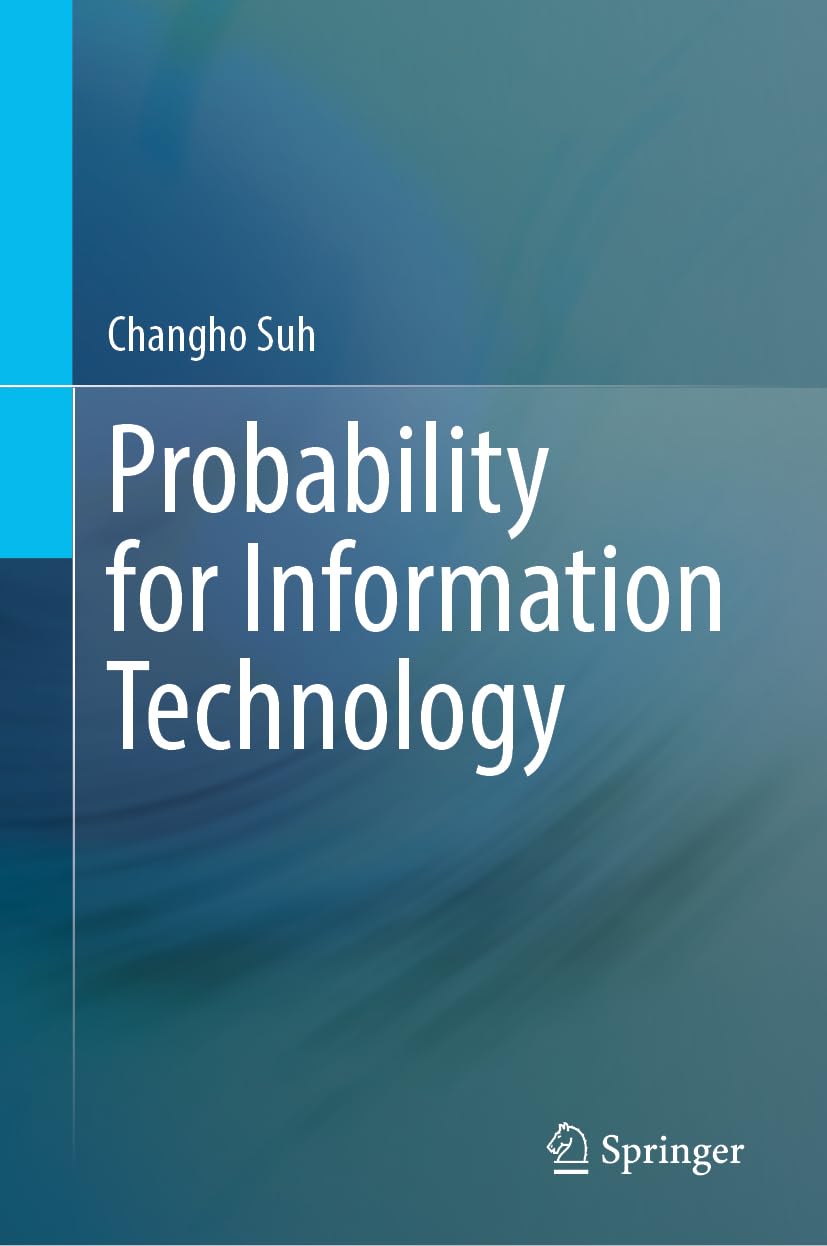
Book
Probability for Information Technology
ISBN : 9789819740314
Author : Changho Suh
Publisher : Springer
Year : 2025
Language : English
Type : Book
Description : This book introduces probabilistic modelling and explores its role in solving a broad spectrum of engineering problems that arise in Information Technology (IT). Divided into three parts, it begins by laying the foundation of basic probability concepts such as sample space, events, conditional probability, independence, total probability law and random variables. The second part delves into more advanced topics including random processes and key principles like Maximum A Posteriori (MAP) estimation, the law of large numbers and the central limit theorem. The last part applies these principles to various IT domains like communication, social networks, speech recognition, and machine learning, emphasizing the practical aspect of probability through real-world examples, case studies, and Python coding exercises. A notable feature of this book is its narrative style, seamlessly weaving together probability theories with both classical and contemporary IT applications. Each concept is reinforced with tightly-coupled exercise sets, and the associated fundamentals are explored mostly from first principles. Furthermore, it includes programming implementations of illustrative examples and algorithms, complemented by a brief Python tutorial. Departing from traditional organization, the book adopts a lecture-notes format, presenting interconnected themes and storylines. Primarily tailored for sophomore-level undergraduates, it also suits junior and senior-level courses. While readers benefit from mathematical maturity and programming exposure, supplementary materials and exercise problems aid understanding. Part III serves to inspire and provide insights for students and professionals alike, underscoring the pragmatic relevance of probabilistic concepts in IT.
RECOMMENDED BOOKS
Crash course public health, epidemiology and sociology
Jack Haywood
Handbook of Blockchain Analytics
Cathy Yi-Hsuan Chen
Computational Intelligence, and Smart Technologies in Solar Thermal Systems
Bharti Sharma
Materials Data Science
Stefan Sandfeld
AI-Driven Cybersecurity for Intelligent Healthcare Systems
Balamurugan Balusamy
Handbook of aging and the social sciences
Kenneth Ferraro

Leadership
Stefanie K. Johnson
Authoritarian Actors and Strategic Digital Information Operations
Ihsan Yilmaz